brain cancer
care app
brain cancer
care app
brain cancer
care app
User Research · Product Design · Digital Prototyping
USC Convergent Science Institute in Cancer
USC Iovine and Young Academy, 2020
Advised by: Dr. Samir Chatterjee
In collaboration with: Alyssa Goldberg, Shantanu Jhaveri, Dylan Wan
01 CLIENT
USC Michelson Center for Convergent Bioscience: Convergent Science Institute in Cancer, USC's leading lab for predicting individualized cancer treatment.
02 problem
a) Physicians lack visibility into a patient's daily living between appointments.
b) Patients and caregivers cannot easily contribute to their electonic health record.
Focus: Glioblastoma, a fast-growing, terminal brain cancer. Because it progresses quickly and treatment decisions are time-sensitive, the value of daily insight is especially high.
03 target audience
Caregivers of glioblastoma patients, and the oncologists treating them.
04 RESEARCH
I initiated and led the user research initiative: conducting interviews with glioblastoma patients and caregivers, and with physicians and oncologists, alongside study of the disease itself, existing healthcare systems, and the daily lifestyle of terminal brain cancer patients.
Caregivers were already being asked to track how the patient was doing, but the systems for it didn't fit their reality:
"The doctors ask us to track how we're feeling, but with the overload of information, I don't have time to track how we're feeling on a regular basis. It practically changes every hour of the day. I'm trying to keep pills down and schedules going and getting him to move and walk."
"We don't have a systematic way of keeping track of things. I need to do a better job of communicating with the doctor."
"There's an app for medications, there's an app for the appointments. I would love one for tracking his physical and emotional health for the day as well."
The data oncologists need already gets generated, in a sense. It just lives in a caregiver's memory, scattered across days, and rarely makes it into the appointment room intact.
05 OPPORTUNITY
A system for caregivers to log holistic, everyday data in the time they actually have, structured so it's directly useful to the oncologist.
06 SOLUTION
Two connected surfaces: a caregiver-facing app, and an oncologist-facing dashboard.
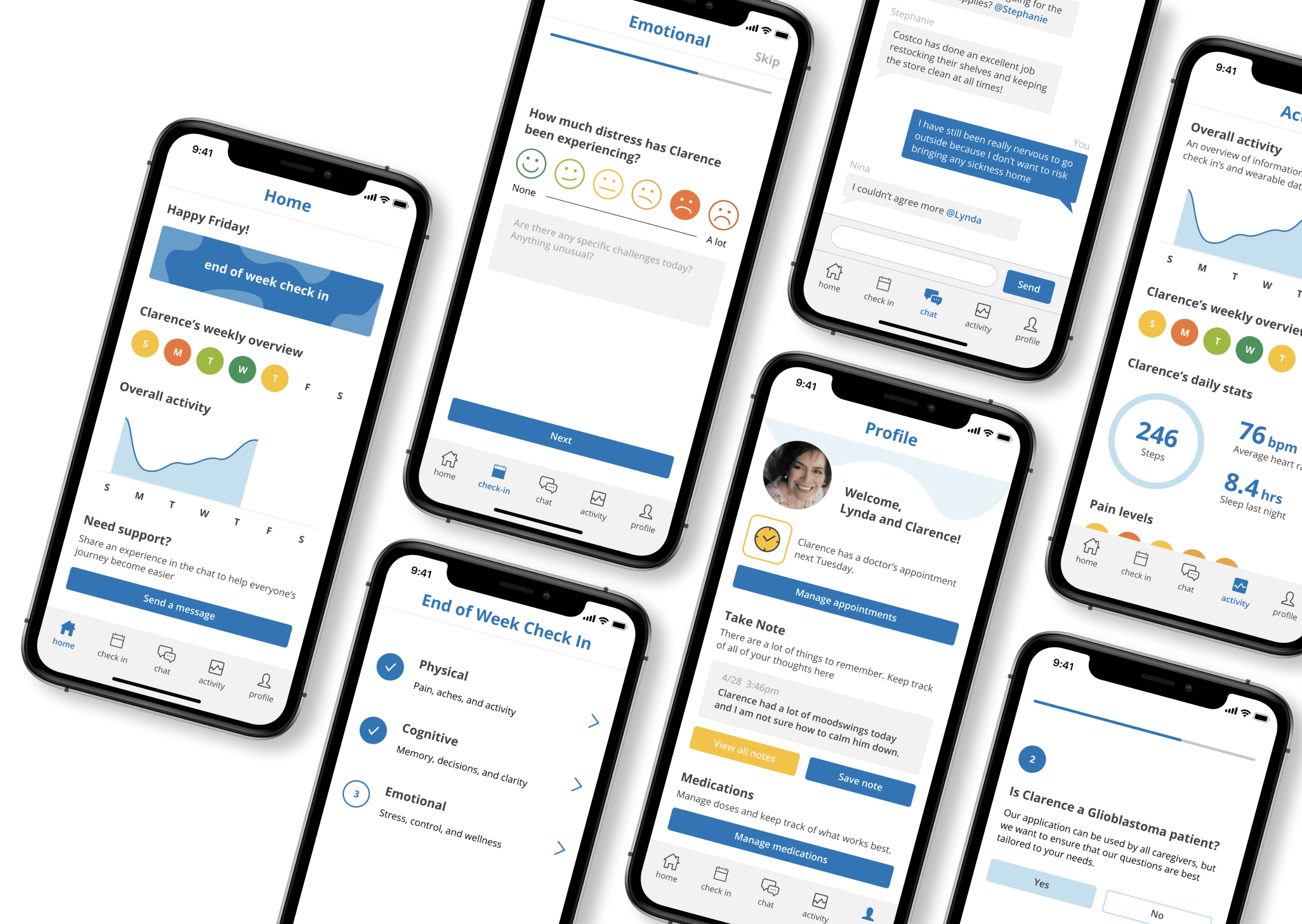
For the caregiver, the app centers on a daily check-in split into three dimensions patients and caregivers had specifically named: physical, cognitive, and emotional. Each is answered in seconds: a five-point mood scale, a low/medium/high selector for stress, aggression, or distress, with an optional note only when something's actually worth flagging. That structure came directly from caregivers describing daily tracking as "too much" and "changing every hour." The app asks for a read on the day, not a log of it.
Physical data is handled differently: a connected wearable pulls steps, heart rate, sleep, and pain trends automatically, so the caregiver isn't manually logging vitals on top of everything else. The home screen surfaces this alongside the week's check-in history at a glance, so a caregiver can see the shape of the week without digging.
A chat connects caregivers to each other and to the care team directly, with a shared blog-style feed for the kind of peer support and logistics-sharing that caregivers were already doing informally. A profile holds medications, appointments, and free-form notes, so the scattered information caregivers mentioned keeping track of manually has one place to live.
On the oncologist's side, all of it rolls up into an aggregate patient overview: physical, cognitive, and emotional trends plotted over time as a timeline, laid directly against the patient's actual care timeline (diagnosis, consults, pathology reports, treatments). An oncologist can see, at a glance, how a patient's day-to-day state moved around a treatment decision, not just what happened in the fifteen minutes of an appointment.
07 FEEDBACK
I presented the interactive app prototypes back to the same patients and caregivers I'd interviewed. The common response was: When can I start using this?
The user testing was positive, but I was struck with this question: How do we keep caregivers using the app regularly, over time, so the data is actually useful in patient care? Caregivers are already stretched thin. The app has to ease that load, not add to it. That points to a UI that's warm and motivating rather than clinical, where every check-in gives the caregiver immediate, visible feedback that it's helping their loved one's doctor. The caregivers help the physicians help the patients.
User Research · Product Design · Digital Prototyping
USC Convergent Science Institute in Cancer
USC Iovine and Young Academy, 2020
Advised by: Dr. Samir Chatterjee
In collaboration with: Alyssa Goldberg, Shantanu Jhaveri, Dylan Wan
01 CLIENT
USC Michelson Center for Convergent Bioscience: Convergent Science Institute in Cancer, USC's leading lab for predicting individualized cancer treatment.
02 problem
a) Physicians lack visibility into a patient's daily living between appointments.
b) Patients and caregivers cannot easily contribute to their electonic health record.
Focus: Glioblastoma, a fast-growing, terminal brain cancer. Because it progresses quickly and treatment decisions are time-sensitive, the value of daily insight is especially high.
03 target audience
Caregivers of glioblastoma patients, and the oncologists treating them.
04 RESEARCH
I initiated and led the user research initiative: conducting interviews with glioblastoma patients and caregivers, and with physicians and oncologists, alongside study of the disease itself, existing healthcare systems, and the daily lifestyle of terminal brain cancer patients.
Caregivers were already being asked to track how the patient was doing, but the systems for it didn't fit their reality:
"The doctors ask us to track how we're feeling, but with the overload of information, I don't have time to track how we're feeling on a regular basis. It practically changes every hour of the day. I'm trying to keep pills down and schedules going and getting him to move and walk."
"We don't have a systematic way of keeping track of things. I need to do a better job of communicating with the doctor."
"There's an app for medications, there's an app for the appointments. I would love one for tracking his physical and emotional health for the day as well."
The data oncologists need already gets generated, in a sense. It just lives in a caregiver's memory, scattered across days, and rarely makes it into the appointment room intact.
05 OPPORTUNITY
A system for caregivers to log holistic, everyday data in the time they actually have, structured so it's directly useful to the oncologist.
06 SOLUTION
Two connected surfaces: a caregiver-facing app, and an oncologist-facing dashboard.
For the caregiver, the app centers on a daily check-in split into three dimensions patients and caregivers had specifically named: physical, cognitive, and emotional. Each is answered in seconds: a five-point mood scale, a low/medium/high selector for stress, aggression, or distress, with an optional note only when something's actually worth flagging. That structure came directly from caregivers describing daily tracking as "too much" and "changing every hour." The app asks for a read on the day, not a log of it.
Physical data is handled differently: a connected wearable pulls steps, heart rate, sleep, and pain trends automatically, so the caregiver isn't manually logging vitals on top of everything else. The home screen surfaces this alongside the week's check-in history at a glance, so a caregiver can see the shape of the week without digging.
A chat connects caregivers to each other and to the care team directly, with a shared blog-style feed for the kind of peer support and logistics-sharing that caregivers were already doing informally. A profile holds medications, appointments, and free-form notes, so the scattered information caregivers mentioned keeping track of manually has one place to live.
On the oncologist's side, all of it rolls up into an aggregate patient overview: physical, cognitive, and emotional trends plotted over time as a timeline, laid directly against the patient's actual care timeline (diagnosis, consults, pathology reports, treatments). An oncologist can see, at a glance, how a patient's day-to-day state moved around a treatment decision, not just what happened in the fifteen minutes of an appointment.
07 FEEDBACK
I presented the interactive app prototypes back to the same patients and caregivers I'd interviewed. The common response was: When can I start using this?
The user testing was positive, but I was struck with this question: How do we keep caregivers using the app regularly, over time, so the data is actually useful in patient care? Caregivers are already stretched thin. The app has to ease that load, not add to it. That points to a UI that's warm and motivating rather than clinical, where every check-in gives the caregiver immediate, visible feedback that it's helping their loved one's doctor. The caregivers help the physicians help the patients.